
I'm a Data Analytics Engineer with 9 years of experience building end-to-end data solutions in healthcare and environmental science. I specialize in bridging complex backend engineering with intuitive, user-facing applications — turning fragmented, manual workflows into automated, data-driven systems.
I'm currently pursuing an MS in Computer Science (AI specialization) at Georgia Tech, and hold undergraduate degrees in Physics (B.S.) and Political Science (B.A.). Outside of work I'm passionate about open source package development, computational physics, and mathematics.
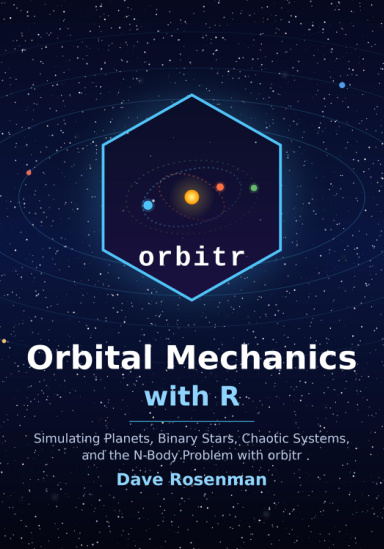
Get in touchA lightweight N-body gravitational simulator for R. Simulate planetary orbits, binary star systems, or chaotic three-body problems in a few lines of pipe-friendly code. Ships a compiled C++ engine via Rcpp with a pure-R fallback.
orbit-r.com →A minimal, user-friendly R interface for connecting to Microsoft SQL Server.
View on GitHub →A Python package for importing and exporting tables between Polars and Microsoft SQL Server.
View on GitHub →How can one element — just three protons — be a metal that catches fire in water, the calm ion in your bloodstream, a mood-stabilizing medication, and the battery in nearly every device you own? This article follows lithium through its wildly different forms, showing how a single loosely held electron explains it all, first through pure intuition and then through the underlying chemistry.
Read more →What would gravity feel like on an infinitely wide, perfectly flat slab of rock? Using symmetry arguments and a Newtonian derivation, this article shows why gravity above such a world stays constant with altitude — no orbits, no escape velocity, and none of our usual spherical-planet intuition.
Read more →If gravity never weakens with altitude, what happens to the atmosphere? Building on Episode 1, this piece uses hydrostatic equilibrium and the ideal gas law to show that the atmosphere thins exponentially but never truly ends — no edge, no boundary, just sky fading forever upward.
Read more →A microwave oven is an imperfect Faraday cage. Using real Wi-Fi speed tests at 2.4 GHz and 5 GHz, this article connects a kitchen appliance to electromagnetism concepts: metal shielding, waveguide cutoff, evanescent decay, and signal attenuation.
Read more →Tracing the internet signal backward — from Wi-Fi radio waves, to the router and modem, to buried cables under the street. Covers why fiber optic beats coaxial cable, how total internal reflection traps light in glass, and why mesh Wi-Fi often outperforms one powerful router.
Read more →An exploration of radioactive decay physics and how it's used to determine the age of lunar rocks.
Read more →An introduction to radiocarbon dating — how the steady decay of carbon-14 is used to estimate the age of once-living material, and what sets the method's practical range and limits.
Read more →The dot product looks like a simple formula, but it quietly underpins geometry, physics, and machine learning. This article builds it up from the ground, connecting the algebraic definition to the geometric one, explaining why it measures projection and alignment, and showing why this humble operation turns up almost everywhere.
Read more →Starting from Taylor series expansions for exponential, sine, and cosine functions, this paper shows how these ideas connect in the world of complex numbers and lead to a surprisingly elegant relationship between some of mathematics's most important constants.
Read more →